Sunday, October 30, 2016
Facts I didnrrrt understand the city I reside in Birmingham Alabama
We have are now living in Birmingham, AL most of my well being and i also found this short article that gave some inside details about the city I reside in that I had no clue about. http://www.razamicro.com/short-history-birmingham-al/

Saturday, October 29, 2016
What's Up? A Glimpse in the Wonderful Town of Ocala
Not long ago i visited Ocala, Florida due to this article. Be sure you take a look! http://www.824tf.com/ocala-florida/
Tuesday, October 25, 2016
The Cutest Bird on the Planet - The Parrotlet
 I have been previously searching for a new pet and decided on a bird. I think I discovered an ideal one - the parrotlet. Don't you think the cutest thing? Be sure you share! https://ecotekluxuryhomes.wordpress.com/2016/10/17/fly-babies-aviary/
Urban Man Cave / Inhouse Brand Architects
.jpg?1477153335 "© Riaan West")
© Riaan West
.jpg?1477153530) title="© Riaan West "
title="© Riaan West "
alt="© Riaan West "
height="125" width="125">
.jpg?1477153461) title="© Riaan West "
title="© Riaan West "
alt="© Riaan West "
height="125" width="125">
.jpg?1477153444) title="© Riaan West "
title="© Riaan West "
alt="© Riaan West "
height="125" width="125">
.jpg?1477153566) title="© Riaan West "
title="© Riaan West "
alt="© Riaan West "
height="125" width="125">
Architects: Inhouse Brand Architects
Location: Cape Town, South Africa
Area: 195.6 sqm
Project Year: 2016
Photographs: Riaan West
.jpg?1477153409 "© Riaan West")
© Riaan West
What can only be described as the ultimate “man cave”, Inhouse Brand Architects has converted the unused lounge area of a Cape Town residence into an industrial-inspired dream pad for the family's lucky teenage boy and his friends.
Taking into account the youngster's various interests such as skating, surfing and socialising, the Inhouse team aimed to create a trendy, multifunctional space. The project was steered by Creative Director Aidan Hart, and Associate Director Jenine Bruce, who chose a modern industrial aesthetic for this youthful interior.
.jpg?1477153392 "© Riaan West")
© Riaan West
Polished concrete flooring encompasses the entire room and sets the foundation for the interior scheme. More notably, a fully functional concrete skate bowl plays a major part in the design.
This impressive structure was no easy feat. Initially, the bowl was supposed to be built in a stepped down recess, but after realizing that the structure would be too unstable to support the weight of the framework, Inhouse had to come up with an alternative solution.
.jpg?1477153478 "© Riaan West")
© Riaan West
During a six-week process, a revised plan was put into action. An entire floor level was removed; timber fins were crafted in the newfound space to create the frame; flexible plywood and polystyrene were incorporated to shape the backing; sand and rubble were used to fill the level that was taken out; and finally, cement was poured into the structure to solidify the bowl shape.

Plan
Although the process took longer than initially planned, the end result is a deeper and more functional skate bowl - one that will most certainly keep the teen and his friends entertained for hours!
To embellish this remarkable feature, emerging South African street artist, Jack Fox, applied his signature illustrations to the walls surrounding the bowl. The celebrated artist worked without a set design and completed the impromptu artwork in a twelve-hour, non-stop operation.
.jpg?1477153461 "© Riaan West")
© Riaan West
Another striking design feature comes in the form of a grandiose, curved timber wave that cascades from the ceiling down to the floor to create an extraordinary zone for watching movies. This “wave” is crafted out of steel fins that are clad with timber and lit up with three LED strips. It is kitted out with surround sound to produce a genuine movie theatre experience.
The bar area comes equipped with a stylish black Smeg fridge and cleverly positioned surfboard rack, which is not only a functional feature but also displays the seventeen-year-old's most prized possession. The bar itself, which measures four and a half metres, is fashioned from ground and polished concrete, perfectly matching the flooring. Clad with timber, the bar exudes a robust masculinity.
.jpg?1477153444 "© Riaan West")
© Riaan West
Next to the bar and adjacent the timber wave is comfortable booth seating. Framed with timber and upholstered in inviting shades of indigo, this nook provides an enticing 'chill' spot.
Industrial track lighting is installed throughout the space. Soft LEDs are embedded overhead in both the booth seating area and the timber wave, to create ambient lighting. Lastly, steel cage pendant lights are suspended over the bar and contribute to the room's urban-like aesthetic.
.jpg?1477153530 "© Riaan West")
© Riaan West
Product Description.The skate-bowl, bar and flooring are all constructed from concrete, making it the principal material used throughout the space. The ample use of concrete allowed Inhouse to convey an industrial aesthetic that relates to the urban “man cave” interior scheme. Florstore on Trend provided the polished concrete flooring, which set the foundation for the overall look and feel of the room.
frits van dongen's gangnam A5 housing block wins 2016 korean architecture award
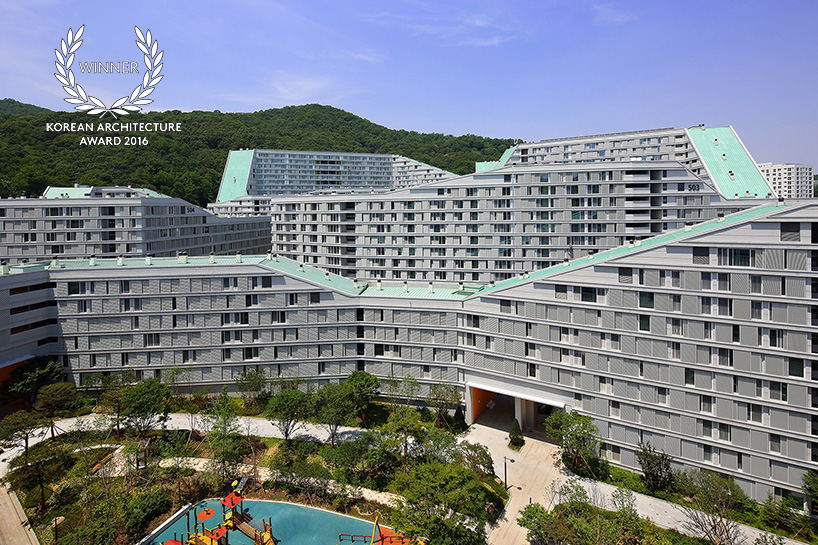
the building complex -- located in seoul's infamously affluent gangnam district --offers affordable public housing for low income families.
The post frits van dongen's gangnam A5 housing block wins 2016 korean architecture award appeared first on designboom | architecture & design magazine.
Monday, October 24, 2016
Alpine Shelter 'Bivak na Prehodavcih' / Premica Architects

© Anze Cokl
 title="© Anze Cokl "
alt="© Anze Cokl "
height="125" width="125">
 title="© Anze Cokl "
alt="© Anze Cokl "
height="125" width="125">
 title="© Anze Cokl "
alt="© Anze Cokl "
height="125" width="125">
 title="© Anze Cokl "
alt="© Anze Cokl "
height="125" width="125">
Architects: Premica Architects
Location: Triglav National Park, 4265 Bohinjsko jezero, Slovenia
Architects In Charge: Aleksandra Penca, Petra Lešek, Goran Djoki, Nataša Voga
Area: 39.0 sqm
Project Year: 2013
Photographs: Anze Cokl
Coordinator: Danilo Istenič
Construction Projects: CBD, d.o.o., dr. Bruno Dujič, Jurij Jančar
Lead Contractor: Rudi Rudnik s.p. and members of PD Radeče
Client: PD Radeče

© Anze Cokl
World War 1 left countries devastated. After the signing of Treaty of Rapallo (1920) on a territory of the latter Yugoslavia, Italy started to build a huge alpine fortification system, which was an enormous engineering feat, consisting of supply roads and paths that led to high-alpine fortresses, outposts and other military infrastructure.

© Anze Cokl
Nearly a century later, Premica Architects from Celje, Slovenia, turned the former shelter – bunker into an alpine shelter for mountaineers. The entire alpine bivouac stands on concrete foundations, on the remains of a former shelter. Supply roads and paths remain almost intact in places and serve as marked hiking paths nowadays. There are hundreds of (parts of) them remaining, offering relatively easy and safe access with even inclination to the high alpine world of this part of the Alps.

© Anze Cokl

Section

© Anze Cokl
The entire bivouac was manufactured and preassembled in a workshop in the valley. The disassemblebled cross-laminated panels were then transported to the location by helicopter. To make transport possible, they were divided into 20 packages of similar weight.
The bivouac stands on concrete foundations, more specifically on the remains of a former bunker from WW1. Shelter features no running water or electricity apart small solar panel for a single wall-light inside. Toilet is a tiny separate building 50 m away.

© Anze Cokl
Presenting the fundamental contrast between people's needs and their relationship with nature, bivouacs address the surrounding terrain with understanding, which is of key significance in interventions into sensitive wild environments. On the one hand, the Prehodavci bivouac continues the tradition of light prefabricated alpine shelters, and on the other, it further develops it by exploring the boundaries of comfort.

© Anze Cokl
Despite technological simplicity and robustness, the structure brings a touch of modernity and coziness into this alpine wilderness. Bivouacs address the fundamental gap between people's needs and their attitude to nature through the understanding of the surrounding terrain, which is of key significance in interventions into sensitive wild environments.

© Anze Cokl
Product Description. Storaenso timber construction and cross-laminated wooden panels were chosen for two main reasons: pleasant and cozy final look of the interior and good strength to weight ratio with relatively easy and quick installation. Wood is a natural element and thus blends in perfectly with the sensitive nature of the Triglav National Park.
The assembled construction has the final natural wood look and feel on the inside, whereas the high quality Prefa façade and roof panels protect the outside. The asymmetric walls ensure wind retention and offer natural snow shedding capabilities, preventing any kind of accumulation on top. Materials are time tested and proven to withstand the
Garden House / Ho Khue Architects
© Hiroyuki Oki
 title="© Hiroyuki Oki"
alt="© Hiroyuki Oki"
height="125" width="125">
 title="© Hiroyuki Oki"
alt="© Hiroyuki Oki"
height="125" width="125">
 title="© Hiroyuki Oki"
alt="© Hiroyuki Oki"
height="125" width="125">
 title="© Hiroyuki Oki"
alt="© Hiroyuki Oki"
height="125" width="125">
Architects: Ho Khue Architects
Location: 678 Điện Biên Phủ, Thanh Khê, Q. Thanh Khê, Đà Nẵng, Vietnam
Architect In Charge: Ho Khue
Design Team: Huynh Thanh Hai, Huynh Van Khanh
Area: 700.0 sqm
Project Year: 2016
Photographs: Hiroyuki Oki
Design And Construction: ALPES Green Design & Build
© Hiroyuki Oki
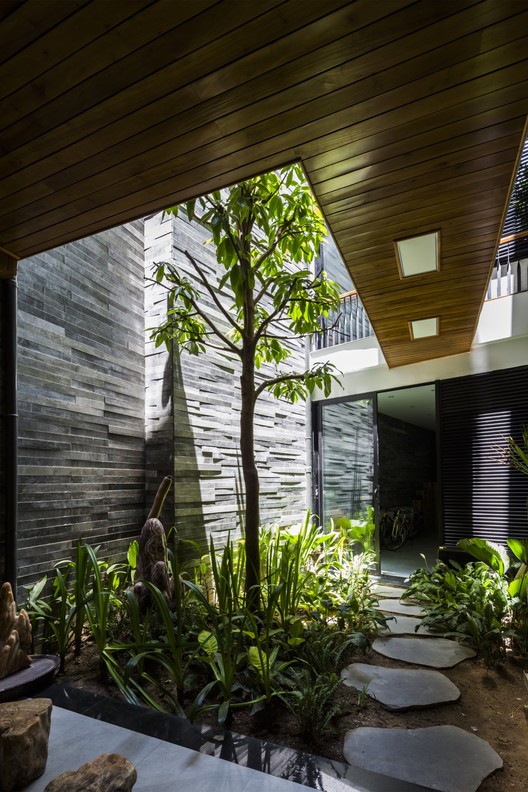
The house land dimensions are narrow 4 meters (w) x 40 meters (l). Key elements and challenges are related to the ratio of the length to the width which effect natural lighting and ventilation. Breakthrough design solutions created two separate blocks with a natural green garden located in the central core.

© Hiroyuki Oki
Beautiful bridges connect the two blocks through corridors landscaped with trees and decorative brick. This centralized open garden area allows breathing and ventilation throughout the house in addition to allowing natural light into all rooms.

© Hiroyuki Oki
Facade
The façade of this 4 story home covered with trees and planter boxes with captures the imagination of people travelling on this very busy commercial road Dien Bien Phu near the recently completed overpass. The concrete slabs and rustic tiles are stacked close together with just enough trees growing to reduce dust and noise from the street. This offers natural and ongoing purification of the air inside the house.

© Hiroyuki Oki
Open Central Core
The 3rd floor garden space connects the parent's master bedroom and the family room. The path that leads through the central core garden is peaceful, cool, and quiet. The cooling air and natural light provides ideal living conditions throughout the house.

Diagram
Sky garden: Beauty, Entertainment, and Cooling
The idea and design solution of the “Green House” includes a 4th floor space with an open "sky garden" planted with tall trees and lush grass, wanting to put a Green Space into a townhouse which is situated in a noisy and cramped area.

© Hiroyuki Oki
The entire roof of the house will also be planted with clean vegetables and flowers providing the family with food and flowers throughout the year. The rooftop garden is created to reduce heat radiation into house and drastically reduce home heating. Solutions for the roof garden began as phase 1 (completed) of the technical construction. Plans to complete the rooftop garden are expected to be completed early next year.

Roof Plan
Brick Design: Natural Air Flow
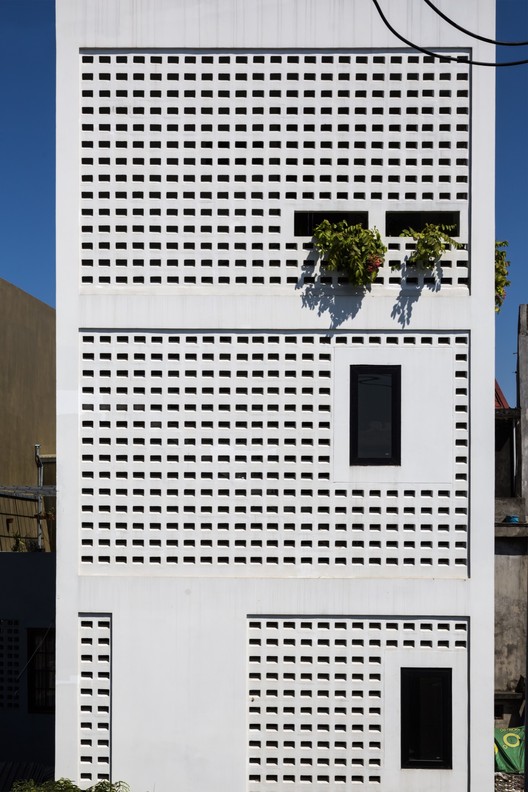
The rear of the building borders a road 5.5 m wide, and is heavily influenced by the hot sun and strong winds from the north-west. The back wall of the rear stairs is constructed using our brickwork with small vents throughout the wall. These are designed to prevent the rain from entering the home while providing ventilation at every level. This facade is always cool, dry, and provides natural light without any heat typical of larger windows and opening.

© Hiroyuki Oki
Natural Materials: Strong and Beautiful
The house is a “Green House” because of design solutions for natural ventilation and cooling, natural lighting, green trees and plants covering the entire house and roof. Environmentally friendly materials like unburned brick, concrete slabs, natural stone, and plantings produce a beautiful and strong surface.

© Hiroyuki Oki
YKK Windows and Products
YKKap Green Certified Windows and doors are used throughout the project. These are lightweight, beautiful, extremely strong, and are the most advanced windows available today.

© Hiroyuki Oki
Secret Garden House / Wallflower Architecture + Design
.jpg?1476927661 "© Marc Tey")
© Marc Tey
.jpg?1476927845) title="© Marc Tey"
title="© Marc Tey"
alt="© Marc Tey"
height="125" width="125">
.jpg?1476927812) title="© Marc Tey"
title="© Marc Tey"
alt="© Marc Tey"
height="125" width="125">
.jpg?1476927344) title="© Marc Tey"
title="© Marc Tey"
alt="© Marc Tey"
height="125" width="125">
.jpg?1476927754) title="© Marc Tey"
title="© Marc Tey"
alt="© Marc Tey"
height="125" width="125">
Architects: Wallflower Architecture + Design
Location: Bukit Timah, Singapore
Architects In Charge: Robin Tan, Cecil Chee, Sean Zheng, Shirley Tan & Eileen Kok
Project Year: 2015
Photographs: Marc Tey
.jpg?1476927717 "© Marc Tey")
© Marc Tey
The Secret Garden House, designed by Singapore based Wallflower Architecture + Design, is situated in the good class bungalow area of Bukit Timah. The owner's brief was to have a luxurious, tropical, contemporary family home. Being the owners of a construction company and by building it themselves, it would also showcase their professional capabilities.
.jpg?1476927694 "© Marc Tey")
© Marc Tey

Diagram
.jpg?1476927856 "© Marc Tey")
© Marc Tey
The house sits on an L-shaped site with a narrow and unassuming frontage; On all sides it is surrounded by neighbouring homes. Further in and on a slight rise, the bulk of the land is not visible from the entrance. Most local home buyers would regard the uneven terrain, narrow frontage and lack of prominence as a disadvantage. The architect saw an opportunity in using the terrain to camouflage the bulk of a large house, and the lushness of a secret garden to screen it from prying eyes.
.jpg?1476927261 "© Marc Tey")
© Marc Tey

1st Floor Plan
.jpg?1476927368 "© Marc Tey")
© Marc Tey
As the spatial and functional requirements were substantial, the architect positioned over a third of the house into the rising land profile, effectively hiding this mass by leveraging on the unique site. The perceived ground floor was set one level above. It allowed for greater privacy from the entrance road and a 'plateau'-like terrace to compose the rest of the living spaces and gardens.
.jpg?1476927285 "© Marc Tey")
© Marc Tey
Visitors are welcomed into the house via a granite cave entrance leading to an 'underground' lobby. The prominence of a steel and glass spiral staircase leads visitors up to the living room. The owners had liked the idea of detaching the living and dining spaces and surrounding these by pools and gardens. This 'plateau' ground level was planned to be a space that blended indoor and outdoor, soft-scape and hard-scape. It was to be one-space, with several programs, rather than many spaces with determined boundaries and fixed functions. Trees planted heavily around the perimeter form a very private enclosure. Visually secure from outside, the ground plain architecture could then be open and transparent without the owner's privacy being compromised.
.jpg?1476927812 "© Marc Tey")
© Marc Tey
Conceptually, the above ground architectural composition is of two rectangular travertine blocks sitting on slender pilotis. The blocks are connected at the second floor by an enclosed bridge floated above the ground plane. A ribbon window cuts around the travertine stone façade. Adjustable vertical timber louvers lined strategically along this band of windows shield the glazing and regulate how much sunlight reaches the interior, as well as ensuring privacy when required.
.jpg?1476927251 "© Marc Tey")
© Marc Tey
An outdoor living deck and roof garden tops-off the composition, and is usefully spacious enough for social gatherings and parties. The deck's facing is angled to enjoy views to scenic Bukit Timah Hill, the highest point in Singapore.
.jpg?1476927624 "© Marc Tey")
© Marc Tey

Attic Floor Plan
.jpg?1476927636 "© Marc Tey")
© Marc Tey
Basic architectural principles of orientation, thermal mass, sun-screening and natural ventilation are fundamental to the design. It is a house designed for the tropics, expressed by modern materials and contemporary aesthetics. Every floor is designed to be cross-ventilated. Primary to the design ethos are that breezes are to be encouraged and unhindered. In the basement, air flows through the large cave-like garage opening, through the timber slatted lobby and exits via a sizable sunken garden courtyard at the rear that is open to the sky. Above ground, the lifted bedroom blocks are kept passively cool by layers of masonry, air cavities, travertine stone cladding, roof gardens and pergolas. Windows cut heat entry via low-emission glass and timber sunscreens filter the strong tropical sunlight, and transform it into a pattern of light and shadows that play into the interior spaces. Skylights further animate the experience in the course of the day through ever-shifting shafts of light. When the situation necessitates, the entire home can be closed off to tropical rain storms or the haze from pollutive burning.
.jpg?1476927614 "© Marc Tey")
© Marc Tey
The environment engifts you when there is respect and collaboration with both its strengths and weaknesses. In spite of being on an intensely urbanized island with one of the highest population densities in the world, the house recaptures what it is to privately enjoy living in the tropics, with its lushness, vibrancy and beauty ensconced in a secret garden.
.jpg?1476927765 "© Marc Tey")
© Marc Tey
Subscribe to:
Comments (Atom)